Openers · Hamilton
Garage Door Opener Replacement
Press the button and the motor hums, but the door stays exactly where it is. Under the housing there is a dusting of white plastic shavings, the sign of a stripped drive gear, and this is the second time it has happened.
Garage Door Opener Replacement
In plain words
Winter is hard on an old opener and a good reason to renew one. Cold thickens grease in a worn chain drive, a tired motor stalls on a door whose seal has stuck to the slab, and an ice storm that cuts the power leaves the door dead when you least want to be outside. A current operator handles all three better: it is rated for detached-garage temperatures, its force limit reverses off a frozen seal instead of straining, and a backup battery runs it through an outage. The technician fits it, tunes it for the cold and shows you the manual release for the rare day it is needed.
How the visit goesDuring the ice storm the power was off for two days. You came home in the dark, found the door dead, and had to climb out of the car to pull the red cord in the cold. A door that keeps working through an outage is now on the list.
Hamilton
How the visit goes
Power at the ceiling
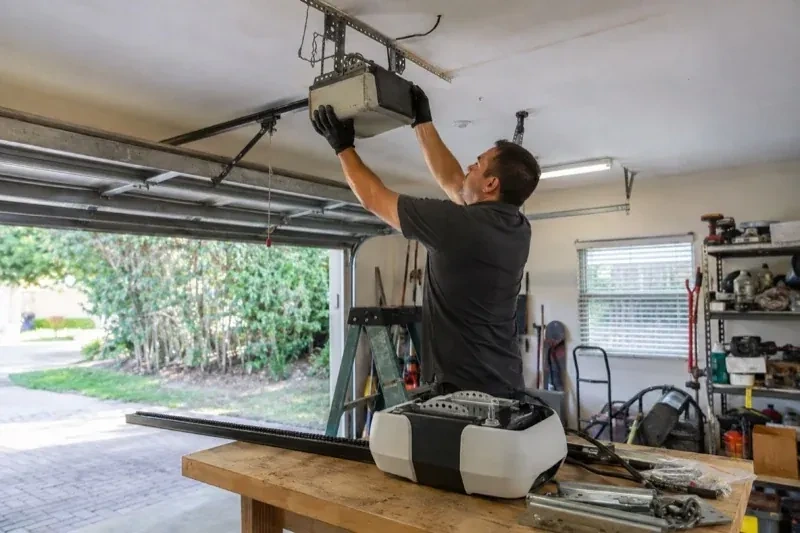
Every operator plugs into a grounded receptacle close to the head unit, so the technician looks for one and checks how it is fed. Many older garages have no ceiling receptacle at all and the old opener has been running from an extension cord draped across the joists, which is a habit worth ending with the new installation. If a receptacle needs adding or moving, that is a job for a qualified electrical contractor, ideally arranged before installation day. The technician also notes whether the garage has Wi-Fi reach if a connected opener is on the wish list.
Setting travel and force
With power on, the technician teaches the operator where the door starts and stops. Newer units run a learn cycle that measures the travel and the effort the door needs; others have open and close limit screws and force dials that are set by hand. The close limit is set so the bottom seal compresses gently against the floor without the door straining, and the open limit so the top section stops short of the header bracket. Force is set to the lightest level that moves the door reliably in the garage's normal temperature, which is what lets the operator notice an obstruction and reverse rather than push through it.
New codes, and old remotes that no longer work
Every press of a new remote sends a code the operator has never seen before, so a signal recorded in your driveway is useless a moment later. The memory was cleared before your remotes were taught, which means any remote from the old unit, including one that went missing along with your house keys, is now just a piece of plastic. Keep the keypad code to yourself and change it if it has been shared with a contractor or house sitter; the console guide shows how. Adding a remote later is a matter of holding the learn button and pressing the new remote, and the technician leaves you with those steps written down.
Garage Door Opener Replacement
In the van
- Rail sections and trolley
- Header bracket and lag screws
- Backup battery
- Door arm and door bracket
- Photo-eye sensors
What affects the quote
Same fees day, night or weekend
1A second door on the same visit
Replacing two operators in a double garage, or one at the house and one at a detached workshop, shares the travel and setup and is quoted as one visit with two installations.
2Working around what is in the garage
A vehicle lift, a storage loft, ductwork or shelving where the rail will run, or a garage that cannot be emptied before the visit, adds handling time that the technician accounts for after seeing the space.
3Lighting options
Built-in LED lamps come with most heads, while a motion-activated light, an extra remote light fixture or a brighter light kit for a workshop are add-ons listed on their own.
Garage Door Opener Replacement: questions
How long does an opener replacement take?
Plan on about half a day for a straightforward swap on a balanced door: removal, hanging the new rail and head, wiring the sensors and console, setting travel and force, running the safety tests and programming remotes. If the door balance check turns up spring or roller work, or a receptacle needs adding by an electrical contractor, allow extra time or a second visit for that part.
Should an opener from before the mid-1990s be replaced rather than repaired?
Manufacturers recommend replacing units made before 1993, since most lacked external entrapment protection such as a photo-eye pair, a sensing edge or a constant-contact close control. Identify the model rather than guessing its age or remote type, since a fixed-code remote with small switches is not proof by itself. Replacing rather than repairing brings the sensor beam, a contact-sensitive force setting, remotes whose code changes on every press and a console lock button.
The door is frozen to the floor. Why does the opener reverse?
Because the operator is protecting the door. Its force setting is tuned to the small effort a balanced door needs, so a seal glued to the concrete by ice registers as an obstruction and the door heads back up rather than ripping the rubber or bowing the top panel. Loosen the seal with a plastic scraper or a hair dryer along the sill, then try again; a shovelled threshold before a cold night keeps it from recurring.
Openers & Access
- Chain-Drive Opener RepairThe door opens about a third of the way and stops.
- Belt-Drive Opener RepairThe belt looks fine from a distance, but up close the rubber has cracked across the back in dozens…
- Photo-Eye Sensor Alignment or ReplacementAfter a cold night the door stays open until the garage warms up.
Garage Door Opener Replacement near you
Broken spring, snapped cable, door off the track, opener humming but not lifting, remote lost, seal cracked, panel dented, door too loud for the bedroom above: those are the calls we take from Hamilton, and each has its own service page explaining how we handle it.