Openers · Hamilton
Belt-Drive Opener Repair
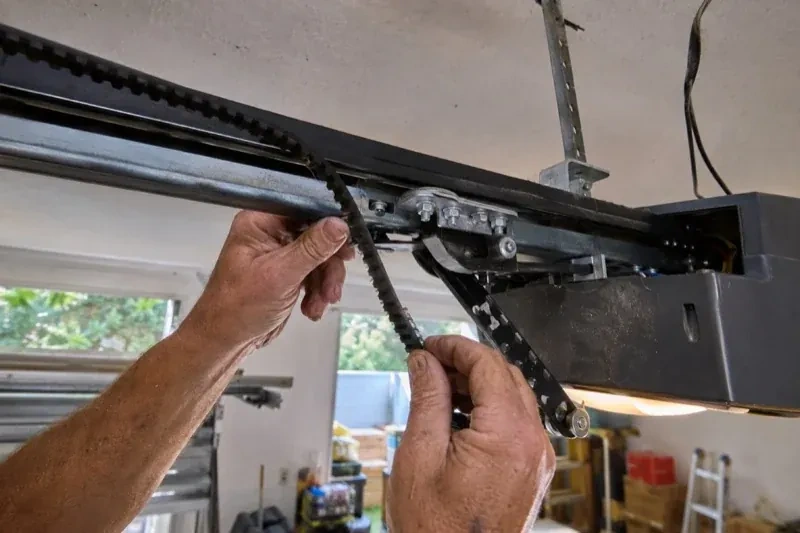
The belt looks fine from a distance, but up close the rubber has cracked across the back in dozens of places and, in one spot, you can see the steel cords showing through.
Belt-Drive Opener Repair
In plain words
Winter is a good season to have a belt drive looked at. Rubber stiffens in a cold detached garage, so a belt tensioned on a warm day can run tight and noisy in January, and a bottom seal frozen to the slab makes the operator reverse before the door has moved. Belt-drive opener repair in cold weather sets tension to the maker's specified measurement, frees a trolley release that has stiffened, frees a door frozen to the floor before the opener moves it, and puts a cold-rated lubricant on the door hardware. The belt stays dry; the hinges, rollers and springs get the care.
How the visit goesPress the remote and the motor runs its full cycle, lights on, the usual whir, but the door does not move a centimetre. Up at the trolley, the belt is hanging loose where a small plastic clip used to hold it.
Hamilton
How the visit goes
Reading the belt from end to end
With the trolley run to one end of the rail and then the other, the whole length of the belt passes under the technician's eye and fingers, on the top run and the return. What they are looking for is specific: cracks across the back of the rubber, a glazed shine that says the belt has been slipping, an edge gone fuzzy from rubbing, a stretch where the teeth are flattened or torn away, cords showing through, and the state of the clip or link where the belt meets the trolley. Each of these points to a different cause as well as a different repair, and where the wear sits along the belt says a lot about which.
Replacing the trolley
A cracked, worn or stuck trolley is removed by unclipping the belt, unhooking the door arm and sliding the assembly off the end of the rail, which on many models means loosening the rail at the header bracket first. The new trolley slides on, the belt is reconnected with a fresh clip, the tension spring and square nut are set, and the door arm is pinned back to the outer half. The technician works the release lever several times to be sure the halves part and lock as they should, then runs the door by motor. Play between trolley and rail is checked, since a loose trolley rattles and wears the belt edge.
A door that is balanced under a belt that is right
Because the door was tested by hand before the belt was touched, you leave with the springs and the drive in agreement. Once a season, with the door closed, unplug the operator, pull the release and lift the door to about a metre: it should stay there. If it drifts down or creeps up, the springs have moved and the belt will soon be working harder than it should, so book a spring adjustment before the belt shows it. A door that hesitates at one point in its travel with the operator disconnected is telling you about a roller or a hinge rather than the belt, and that too is a small visit.
Belt-Drive Opener Repair
In the van
- Inner and outer trolley
- 2x4 offcut for the reversal test
- Door arm and clevis pins
- Idler pulley and bearing
- Drive gear and sprocket kit
What affects the quote
Same fees day, night or weekend
1Sensors and controls needing attention
Photo eyes out of alignment or too high, a wall control below the recommended height or a release handle out of reach are corrected during the visit and listed separately.
2Rail straightening or re-hanging
A bent rail, a sagging hanger or a misaligned rail joint that has been fraying the belt is corrected as part of the repair so the new belt runs clean, and the labour appears on the quote.
3Trolley condition
A trolley that releases and re-engages cleanly stays. One that is cracked, stuck or loose on the rail is replaced during the same visit and listed as its own part.
Belt-Drive Opener Repair: questions
Will the safety sensors be tested as part of the repair?
Yes, every time. After the drive work and the relearning of travel and force, the technician runs the door onto a 2x4 laid flat on the floor to confirm it reverses on contact, and passes an object through the photo-eye beam while it closes to confirm it reverses again. The sensors' height and alignment are checked, and the tests are shown to you so you can repeat them monthly.
What does out of phase mean, and why does my door stop short?
When the belt has been off the sprocket, or the motor has run without it, the motor's idea of where the door is no longer matches where the trolley sits. The door then stops short at one end however the limits are turned. The technician lifts the belt off, runs the sprocket to its closed position, refits the belt with the trolley at the closed end and relearns the limits.
What are the signs a belt is wearing out?
Cracks across the back of the rubber, a shiny glazed surface, a fuzzy or frayed edge, teeth worn flat or torn away in a stretch, and cords showing through the rubber. The clip at the trolley can also go brittle and snap. Most belts show one of these long before they fail, which is why a glance along the rail every few months catches a repair early.
Openers & Access
Belt-Drive Opener Repair near you
Broken spring, snapped cable, door off the track, opener humming but not lifting, remote lost, seal cracked, panel dented, door too loud for the bedroom above: those are the calls we take from Hamilton, and each has its own service page explaining how we handle it.