New Doors · Hamilton
High-Lift Garage Door Conversion
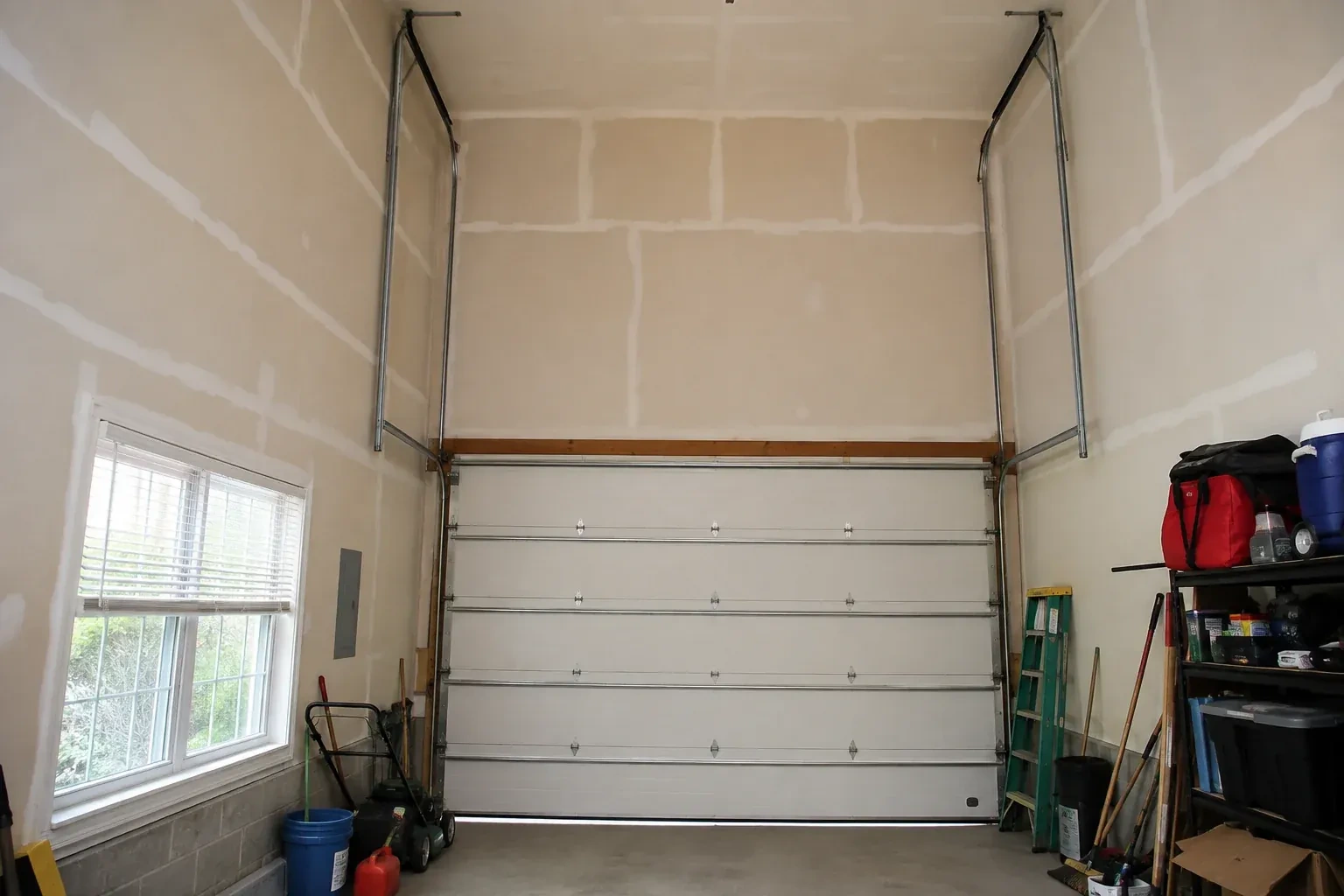
You want to keep the sectional door, but its standard track layout conflicts with a renovation above the parking bay. There is visible room over the opening for the door to climb before it needs to turn inward.
High-Lift Garage Door Conversion
In plain words
A high-lift conversion changes where a sectional door turns from vertical to horizontal travel. Extended vertical track carries the panels farther up the wall, then a new transition guides them toward the ceiling. Because that geometry changes cable movement and the force needed through the cycle, the conversion normally includes matched drums, cables and torsion springs rather than track alone. The result is more usable space beneath the open door for a vehicle lift or another planned use, provided measurements, structure and operator placement support the design.
How the visit goesYou want to keep the sectional door, but its standard track layout conflicts with a renovation above the parking bay. There is visible room over the opening for the door to climb before it needs to turn inward.
Hamilton
How the visit goes
Set a measurable feasibility point
Before components are ordered, the assessment should produce a proposed high-lift dimension and an expected lowest point beneath the open door. Those figures are considered alongside spring room, transition radius, shaft elevation, opener location and future service access. The record also identifies assumptions that need confirmation, such as hidden framing or a planned vehicle-lift height. This gives the customer a useful go-forward decision: a defined clearance outcome, a coordinated parts list and any preparatory work that belongs ahead of installation.
Match drums and cables to the new travel
High-lift drums have a contoured cable surface that manages changing leverage as the door climbs. The selected drums are installed on the shaft with new lift cables of the specified length and construction. Each cable is routed from its bottom attachment, seated correctly in the drum grooves and set evenly with its partner. Technicians rotate the system under controlled conditions to observe how both sides wind. Proper drum and cable coordination keeps the door level and maintains useful tension throughout the vertical and curved portions of travel.
Seasonal observation without adjustment
Temperature and humidity shifts can change lubrication behaviour, door weight and how materials move, while road salt and moisture may reach lower hardware. From a safe position, look for smooth travel, an even bottom edge and cables that remain neatly seated. Listen for a new scrape or repeated contact at the transition. Cleaning accessible track surfaces and following the manufacturer-listed lubrication points supports regular care. Spring, cable, drum and bottom-bracket changes remain technician work because those components carry the counterbalance load.
High-Lift Garage Door Conversion
In the van
- Compatible operator hardware
- Centre bearing support
- Calculated torsion springs
- Transition track sections
- Braced back hangs
What affects the quote
Same fees day, night or weekend
1Door and equipment preparation
Removing shelves, ceiling finishes or other items from the planned track and service envelope adds coordination when the bay is not ready for installation.
2Door size and actual weight
Panel construction, reinforcement, glazing and added finishes influence the measured load used to select drums, cables, torsion springs and shaft components.
3Ceiling and wall obstructions
Beams, ducts, pipes, lights, attic openings and sloped ceilings can change track routing, support placement and the amount of usable clearance delivered.
High-Lift Garage Door Conversion: questions
How should I care for the converted tracks?
Keep the track path clear and visually check that brackets remain secure, rollers stay centred and cables wind neatly. Clean debris from accessible areas, but avoid applying grease inside the track unless the door instructions specifically call for it. Lubricate only the points and products identified for the installed system. Loaded spring, cable and bracket adjustments belong in a technician's service scope.
How is high lift different from full vertical lift?
A high-lift door eventually turns and rests in horizontal tracks near the ceiling. A full vertical-lift door continues upward along the wall and has no horizontal storage run. Wall height, ceiling depth, door height and the intended open position determine which geometry suits the building. The component layouts are distinct, so the terms matter during design.
Which parts are commonly replaced in a conversion?
Typical system changes include vertical and transition track, raised horizontal track supports, high-lift drums, longer lift cables, calculated torsion springs and related shaft or bearing hardware. Top fixtures, rollers, brackets and the operator arrangement may also change according to the design. The final list follows measured compatibility rather than a universal kit applied to every door.
Installation & Upgrades
- Insulated Steel Garage Door InstallationThe opener strains as the heavy older door starts upward, and manual movement feels uneven.
- Wind-Rated Garage Door ReplacementYour renovation drawings call for a garage door with a stated design pressure, yet the existing…
- Carriage-House Garage Door InstallationTwo garage openings sit side by side, and small differences in window spacing or decorative…
High-Lift Garage Door Conversion near you
Broken spring, snapped cable, door off the track, opener humming but not lifting, remote lost, seal cracked, panel dented, door too loud for the bedroom above: those are the calls we take from Hamilton, and each has its own service page explaining how we handle it.